
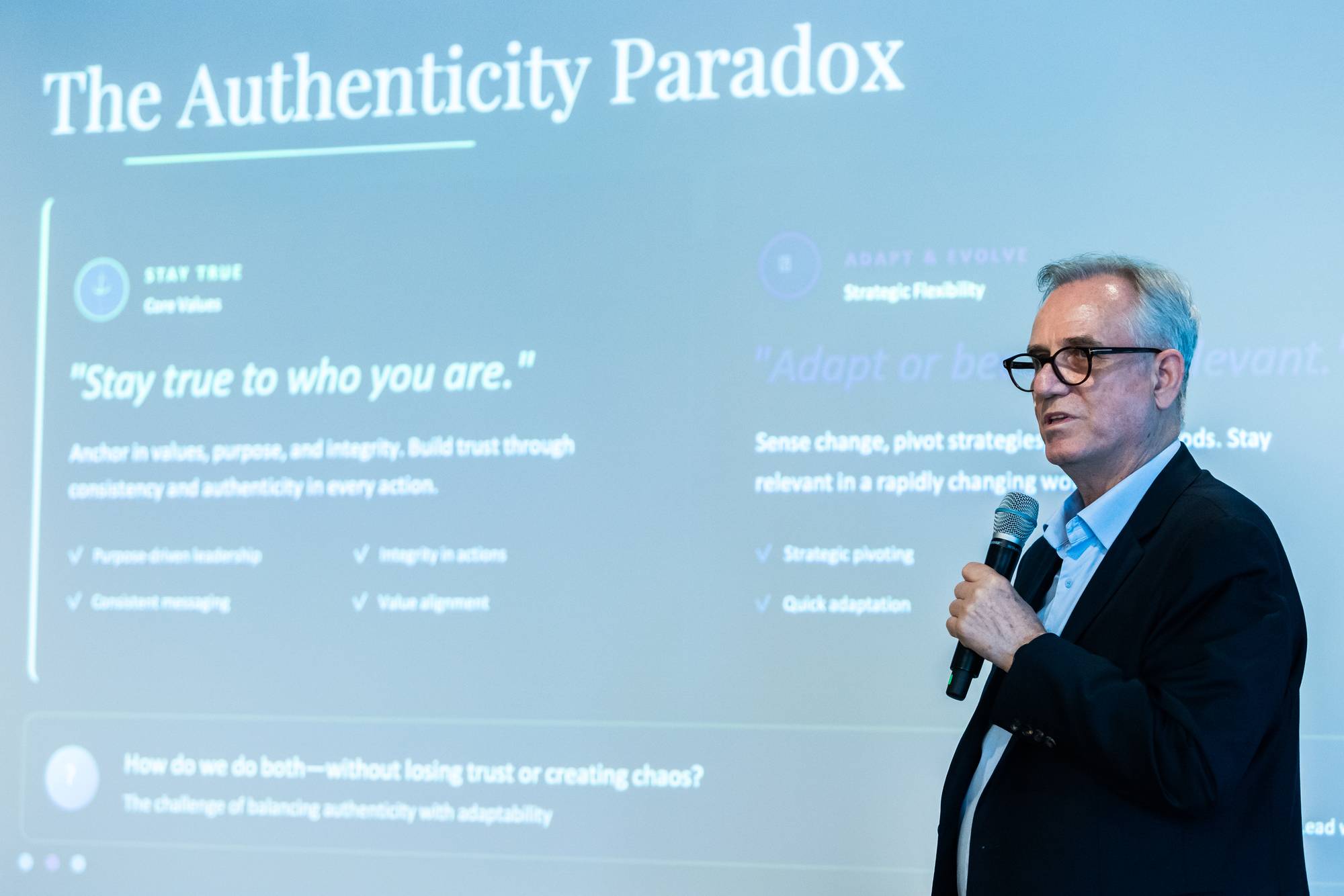
A global leadership keynote should do more than inspire an executive audience. It should help C-suite teams recognize the decision habits that cause sound strategies to lose momentum across markets.
A strategy can be logically sound, commercially ambitious, and unanimously approved by the C-suite, and still lose momentum the moment it meets a different market.
Most leaders have seen this happen.
The initiative is announced with clarity. The logic is strong. The objectives are consistent. Regional teams are asked to align, cascade, and execute.
Then the differences begin to surface.
A local team asks questions that feel inconvenient. A regional leader adapts the approach. One market moves quickly while another quietly works around parts of the plan. Headquarters may interpret the difference as resistance, lack of urgency, or weak execution.
But often, the real problem began earlier.
The decision was made with global responsibility in mind, but through a single-market lens.
That is the global decision gap.
Global responsibility does not guarantee global thinking
Senior teams now make decisions amid cross-border supply chains, multicultural workforces, varied customer expectations, and changing geopolitical realities. Yet global scope does not automatically create a global mindset.
Leaders can have international titles, regional responsibility, and extensive travel experience while still relying on the assumptions that made them successful in one familiar context.
A Global Mindset requires something more deliberate:
- The ability to see an issue through more than one cultural and market lens
- The curiosity to ask what is different before assuming what is wrong
- The adaptability to adjust the path without abandoning the principle
- The integration to bring different perspectives into one coherent direction
This is not about being agreeable or endlessly accommodating. It is about making better decisions before complexity turns into rework, delay, or disengagement.
Three decisions that reveal the gap
The global decision gap tends to appear first in three places.
1. Who the organization trusts with global roles
A leader’s international résumé is useful context. It is not proof of global readiness.
The important question is not only where a leader has worked. It is how that leader has responded when a familiar approach did not fit a new cultural or market reality.
Do they listen before judging? Seek perspectives different from their own? Adapt their approach while remaining clear on the organization’s purpose and standards?
Those behaviors matter because global roles demand more than technical excellence and a passport full of stamps. They demand the capacity to interpret complexity without defaulting to what worked at home.
2. How the organization rolls out strategy across markets
Global consistency is important. But consistency does not always mean one identical route to execution.
A strategy designed around the assumptions, incentives, and communication preferences of one market can be difficult to implement elsewhere, even when the strategic intent is right.
Globally agile leadership teams invite regional insight upstream. They ask which elements of a strategy may be interpreted differently in different contexts. They identify where local adaptation can support the goal rather than dilute it.
That creates alignment earlier, when it is still easy to improve the design.
3. How leaders interpret friction
Friction is unavoidable in complex organizations. The leadership question is what we assume that friction means.
An autopilot response says, “They are resisting change.”
A globally minded response asks, “What might this be teaching us about how the decision is landing?”
Not every objection should change the plan. But every serious objection may contain data: an operational reality, a cultural nuance, a stakeholder risk, or an implementation barrier that the center cannot see clearly.
The most effective leaders create room for constructive dissent without surrendering decision-making responsibility.
What a Global Leadership Keynote Should Change
A global leadership keynote should not simply describe global complexity. It should help leaders build the decision habits to notice weak signals early, widen the field of view, and act with greater intention before friction becomes failure.
Proactive Agility begins before the crisis
Proactive Agility is not simply the ability to react quickly once something goes wrong. It is the discipline of noticing signals early, widening the field of view, and preparing for the complexity that is already forming.
For executive teams, that means building better decision habits before the next strategy rollout, succession decision, market disruption, or organizational change makes those habits urgent.
One practical question can change the quality of a discussion:
Whose perspective is missing from this decision, and what might that perspective help us see?
It is a simple, demanding question. It asks leaders to slow down just enough to challenge their default interpretation before acting.
Why a Global Leadership Keynote Matters for C-Suite Teams
A global leadership keynote should not simply describe global complexity. It should help leaders build the decision habits to notice weak signals early, widen the field of view, and act with greater intention before friction becomes failure.
This is why Global Mindset and Proactive Agility are not abstract ideas for an executive offsite or conference agenda. They are practical leadership capabilities.
A keynote or workshop can help a leadership team:
- Identify where familiar assumptions are limiting global decisions
- Recognize early signals that strategy will land differently across markets
- Build a shared language for curiosity, adaptation, and constructive challenge
- Translate global intent into locally credible execution
- Develop stronger habits for leading through uncertainty and cross-cultural complexity
The goal is not to make leaders hesitant. It is to help them become more intentional, more alert to weak signals, and more capable of moving with confidence across different contexts.
The question for your leadership team
Before your next major decision, ask:
Are we making this decision for a global world, or are we running a familiar playbook on autopilot?
The answer may determine whether your strategy becomes a source of alignment or avoidable friction.
Call to action
If you are planning a leadership offsite, executive meeting, or conference, a global leadership keynote can help your team make stronger decisions amid global complexity. Explore a Proactive Agility and Global Mindset keynote or workshop with Steve McKinney.